
Better decisions underreal uncertainty.
Plume Thinking is a strategic decision-making platform for consequential choices. Chat explores.Plume Thinking converges.
When Plume Thinking is the right tool
Plume Thinking is intentionally designed for a specific class of strategic decisions. It is most useful when all five conditions are present.
- 01Several outcomes genuinely matter at once — financial return, control, reversibility, regulatory standing, speed — and cannot honestly be collapsed into one number.
- 02The available routes fail in different ways, not just more or less of the same thing.
- 03Important uncertainty exists, but it can be structured into defensible states or ranges.
- 04Information arrives before every option disappears — staging, waiting and preserving optionality have value.
- 05One person ultimately owns the decision and can say: I want this; I can live with this; I will not accept this.
Decisions Plume Thinking is well suited for
What Plume Thinking is not for
- ×There is only one meaningful objective.
- ×Every outcome can be reduced to money or another common currency.
- ×The choice is easy to reverse.
- ×The entire decision hinges on one unknown nobody can bound.
- ×You already know the answer and want validation.
Most strategic decisions are not hard because there is too little information. They are hard because there are multiple objectives, conflicting trade-offs, uncertain futures, irreversible consequences — and there is usually no way to have all of these under control in one place.
What a decision session might soon looks like
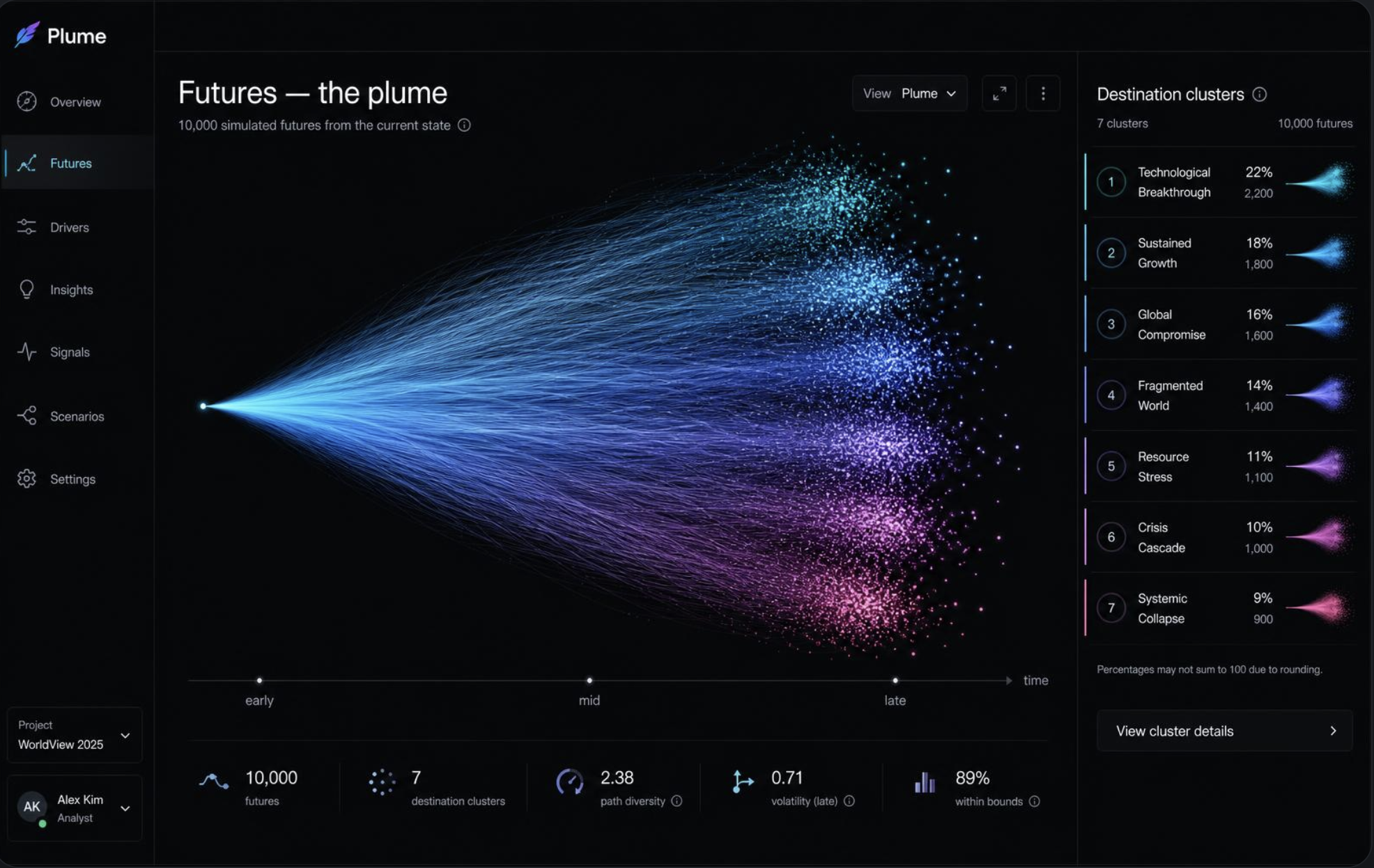
Illustrative rendering of Plume Thinking in use.
Agents for judgment. Mathematics for consequence. Human eye and brain for choice.
Specialist AI agents frame the problem, identify uncertainties and challenge assumptions. A deterministic mathematical engine enumerates configurations, generates scenarios and measures robustness. The human decision-maker owns the preferences and the final choice. Leveraging custom visualization.
Fifty years of decision science, put to work
Plume Thinking invents no new theory. It builds on a field that has spent decades studying how people should choose when outcomes conflict and the future is genuinely unknown - and makes that work usable in an afternoon.
“A good decision is not the same as a good outcome.”
“Values are what we care about — and as such they should be the driving force for our decision making.”
“Seek strategies that perform reasonably well across a wide range of plausible futures, rather than optimally in one predicted future.”
“Wherever there is judgment, there is noise — and more of it than you think.”
- Decisions under uncertainty formalised
- Minimax regret
- Multi-criteria trade-offs
- Value-focused thinking
- Robust decision-making
- Noise in judgment
- Plume Thinking
How Plume Thinking works
Plume Thinking does not try to predict the future. It helps you understand which decisions still make sense when the future refuses to cooperate.
Frame the real decision
Bring the context you already have. Plume Thinking checks whether the decision suits this method — and says so plainly if it doesn't.
Build the decision model
Specialist agents turn your context into an explicit model of the decision. You stay in control of it.
Explore possible futures
Advanced mathematics stress-tests every course across thousands of plausible futures.
React to real futures
You look at concrete futures and say how you feel about them. Plume Thinking learns where your line is.
Compare what holds up
The system shows shows which course still makes sense - and what would change your mind.
The human makes the decision.
Plume Thinking makes the reasoning visible.
More than a recommendation
At the end of a session, Plume Thinking produces a decision memo that records how the decision was framed, what assumptions were used, what you changed, which course proved robust, how it can fail - and what signals to watch after commitment.
Robustness is the justification. The changes of mind are the product.
The real value
- “I understand this decision differently now.”
- “I know what I will not accept.”
- “I can explain why this route is more resilient.”
- “I know what would make me reconsider.”
Facing a decision that fits?
Plume Thinking will soon be in private beta. If you're carrying a consequential choice - multiple outcomes that matter, routes that fail differently, a future that won't sit still - we want to work through it with you.
Tell us the decision you're facing.